
You finally did it. You stopped ordering takeout every single night. You canceled that gym membership you haven’t used since January. You tightened the belt, and now, you are sitting there staring at an extra $1,000 in your bank account.
Thank you for reading this post, don't forget to subscribe!- 1Key Takeaways
- 2Step 0: The “Do Not Pass Go” Prerequisites
- 3The Golden Rule: Do Not Pick Individual Stocks
- 4The Holy Grail for Beginners: Broad Market Index Funds (or ETFs)
- Comparison Table: Where Should Your ,000 Go?
- 5Option 2: The “Hands-Off” Approach (Robo-Advisors)
- 6The Power of the Roth IRA
- 7The Psychological Trap: Timing the Market
- 8Detailed Case Study: The Tale of Two Investors
- Mark’s Path: The Thrill Chaser
- David’s Path: The Boring Millionaire
- Expert Insight: The First 0k is the Hardest
- 9Frequently Asked Questions
- Can I lose more than my initial ,000?
- What happens if the brokerage firm (like Vanguard or Schwab) goes bankrupt?
- Do I have to pay fees to invest my ,000?
- Can I pull my ,000 out if there is an emergency?
- 10Your Action Plan for Today
Key Takeaways
- Clear the Runway First: Never invest if you are carrying high-interest credit card debt or lack a basic emergency fund. Paying off 24% APR debt is a guaranteed 24% return on investment.
- Avoid Individual Stocks: Stock picking is a loser’s game for beginners. Your greatest weapon is diversification.
- Index Funds are the Holy Grail: Buying a broad market ETF (like an S&P 500 fund) allows you to own a tiny slice of the 500 largest U.S. companies instantly, minimizing risk and maximizing long-term returns.
- Shelter Your Profits: Always invest your first dollars in a tax-advantaged account like a Roth IRA, ensuring your compound growth remains completely tax-free upon retirement.
📸 Screenshot Placeholder: Brokerage Dashboard Example (Show a simple, clean UI of an index fund purchase screen highlighting the “Buy” button and a low expense ratio).
First of all, congratulations. For a lot of people, saving that first grand is the hardest financial hurdle they will ever face.
But now comes the terrifying part: What the hell are you supposed to do with it?
If you leave it in a regular checking account, inflation is going to act like an invisible thief, slowly robbing it of its buying power. If you listen to your chaotic friend on Twitter, you might throw it all into some obscure cryptocurrency and watch it evaporate in four hours.
Investing for the first time feels like walking into a casino where everyone speaks a different language, and nobody will tell you the rules. But here is the secret Wall Street doesn’t want you to know: Investing is actually incredibly boring, incredibly simple, and doesn’t require a finance degree.
In this guide, we are going to walk through exactly how to deploy your first $1,000 to start building long-term, stress-free wealth.
Step 0: The “Do Not Pass Go” Prerequisites
Before you even think about buying a stock, we need to do a harsh reality check. Do not invest a single penny of that $1,000 if you violate either of these two rules:
- Do you have toxic debt? If you have $5,000 in credit card debt sitting at a 24% interest rate, DO NOT INVEST your $1,000. Why? Because the absolute best investors in the world might average a 10% return in the stock market. Earning 10% on your money while simultaneously paying the bank 24% in interest means you are still bleeding out. Take that $1,000 and throw it directly at your high-interest debt. It is an immediate, guaranteed 24% return on your money.
- Do you have an emergency fund? If your car transmission blows up tomorrow, or you get laid off, how will you pay for it? If the answer is “put it on a credit card,” you aren’t ready to invest. That $1,000 shouldn’t go into the stock market; it should go into a High-Yield Savings Account to act as a financial shock absorber.
If you are debt-free (excluding a mortgage or low-interest car loan) and you have a small emergency fund, you have the green light. Let’s invest.
The Golden Rule: Do Not Pick Individual Stocks
When most people think of investing, they picture a guy in a suit screaming on a trading floor, yelling “Buy Apple! Sell Tesla!”
This is the biggest mistake beginners make. They try to pick the “next big thing.” They throw their $1,000 into a trendy tech company hoping it doubles overnight.
Listen to me very carefully: Picking individual stocks is a loser’s game. Even the smartest, highest-paid hedge fund managers on Wall Street fail to beat the overall market consistently over a 10-year period. If guys with supercomputers and insider knowledge can’t guess which stock will win, you are definitely not going to do it by reading a Reddit forum.
If you buy a single company’s stock, and that company’s CEO gets caught in a scandal, or their new product fails, your money vanishes. It is too risky.
So, what do you do instead? You buy the entire haystack.
The Holy Grail for Beginners: Broad Market Index Funds (or ETFs)
Instead of trying to guess which individual company will succeed, you can simply invest in an “Index Fund” or an “ETF” (Exchange Traded Fund).
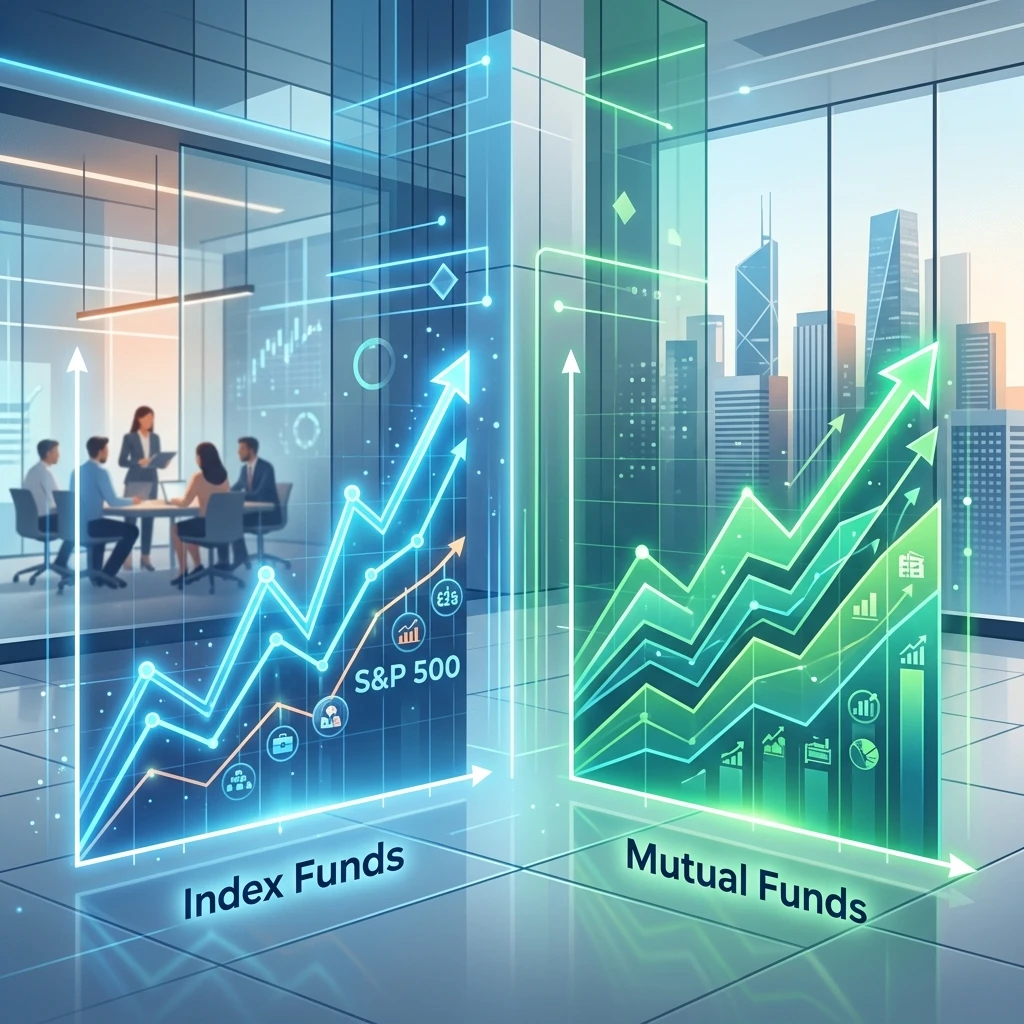
Imagine a massive basket. Inside this basket are tiny slices of the 500 largest, most profitable companies in the United States. You’ve got Apple, Microsoft, Amazon, Johnson & Johnson, Visa—all sitting in the basket.
This specific basket is called the S&P 500.
When you buy a share of an S&P 500 ETF (like VOO, SPY, or IVV), you aren’t buying one company. You are instantly diversifying your $1,000 across 500 different massive corporations.
If one company in the basket goes bankrupt, it doesn’t matter, because the other 499 companies are there to prop up the basket. It is the ultimate safety net.
Historically, the S&P 500 has returned an average of about 7% to 10% per year over the long haul (adjusted for inflation). Some years it drops by 20%. Some years it shoots up by 30%. But over a 10, 20, or 30-year period, it has consistently, relentlessly marched upward.
Legendary investor Warren Buffett famously won a million-dollar bet by proving that a simple, boring S&P 500 index fund would outperform highly paid hedge fund managers over a decade. If it’s good enough for billionaires, it’s good enough for your first $1,000.
Comparison Table: Where Should Your ,000 Go?
| Investment Vehicle | Risk Level | Required Effort | Best For | Typical Fees |
|---|---|---|---|---|
| S&P 500 Index Funds (ETFs) | Moderate (Market Fluctuation) | Low (Buy and hold) | Long-term wealth building | Extremely Low (~0.03%) |
| Individual Tech Stocks | Extremely High | High (Constant research) | Gamblers / Advanced traders | Low (Usually free trades) |
| Robo-Advisors | Moderate to Low | Zero (Completely automated) | Total beginners who want no involvement | Moderate (~0.25% management fee) |
| High-Yield Savings | Zero (FDIC Insured) | Zero | Emergency funds / Short-term cash | None |
Option 2: The “Hands-Off” Approach (Robo-Advisors)
If opening a brokerage account and buying an ETF still sounds too complicated, technology has provided an incredible solution for you: Robo-Advisors.
Companies like Betterment or Wealthfront have gamified and simplified the entire process. You download their app. You answer five simple questions (How old are you? When do you want to retire? How much risk can you stomach?).
Based on your answers, their algorithm builds a custom, diversified portfolio for you automatically. You link your bank account, deposit your $1,000, and… you’re done.
You never have to log in to execute a trade. You never have to rebalance your portfolio. The robot handles everything for a very small fee (usually around 0.25% of your money per year).
For a beginner who wants to invest but literally doesn’t want to think about it ever again, a Robo-Advisor is a phenomenal tool.
The Power of the Roth IRA
Okay, we know what to buy (Index Funds). Now we need to know where to buy them.
You could open a standard, taxable brokerage account. But if you do that, the government is going to tax your profits every time you sell a stock or receive a dividend.
If you are investing for your future, you need to use a tax-advantaged account. The absolute best tool for the average person is the Roth IRA (Individual Retirement Account).
Here is the magic of a Roth IRA: You put money in that has already been taxed from your paycheck. You buy your index funds. Your $1,000 grows and compounds over the next 30 years. Let’s say it turns into $15,000.
When you retire and pull that money out, you pay zero taxes on the profit. None. The government can’t touch it. All of that massive growth is legally tax-free. It is one of the greatest legal tax loopholes available to the middle class.
Crucial Warning: A Roth IRA is just an empty bucket. Putting $1,000 into the bucket doesn’t mean it’s invested. Once the money is inside the Roth IRA account, you have to actually purchase the Index Funds. I’ve heard horror stories of people leaving cash sitting un-invested inside an IRA for five years. Don’t make that mistake.
The Psychological Trap: Timing the Market
Once you invest your $1,000, I can guarantee exactly what you are going to do. You are going to log into your account the next morning to check on it.
You might see that the market dropped, and your $1,000 is now worth $980. Panic will set in. You’ll feel a knot in your stomach. You’ll think, “I knew the stock market was a scam! I need to pull my money out before I lose it all!”
Stop. Breathe.
The stock market is a rollercoaster. It goes up and down violently in the short term. The absolute worst thing you can do is sell your investments when the market is down out of fear. When you do that, you lock in your losses permanently.
You only lose money if you sell. If your portfolio drops 20% during a recession, it’s just numbers on a screen. If you leave it alone, history shows it will recover and climb higher.
Do not try to wait for the “perfect time” to invest. People who wait for the market to crash before investing usually end up missing out on years of growth. Just put the money in, ignore the daily news headlines, and let the economy do the heavy lifting for you.
Detailed Case Study: The Tale of Two Investors
To truly understand the psychological and mathematical impact of what you do with this first $1,000, let’s look at a realistic case study comparing two friends, “Mark” and “David,” who both managed to save $1,000 at age 25.
Mark’s Path: The Thrill Chaser
Mark takes his $1,000 and decides he wants to get rich quickly. He watches a few TikTok videos about a trending penny stock that is guaranteed to “go to the moon.”
He opens a Robinhood account and throws the entire $1,000 into this single, highly volatile tech company. For the first two weeks, he feels like a genius. The stock spikes, and his $1,000 turns into $1,400. He checks his phone 15 times a day, obsessed with the fluctuating line.
Then, disaster strikes. The company’s earnings report is terrible, and the CEO resigns. The stock plummets by 60% in a single morning. Mark panics, feeling sick to his stomach, and sells everything to “stop the bleeding.”
– The Result: Mark walks away with $560. He is traumatized, decides the stock market is a rigged casino, and vows never to invest again. He leaves his remaining cash in a checking account for the next decade, losing thousands to inflation.
David’s Path: The Boring Millionaire
David takes a completely different approach. He opens a Roth IRA at Fidelity. He takes his $1,000 and buys shares of an S&P 500 Index Fund (like FXAIX).
He doesn’t experience any massive spikes. In fact, a month later, the overall market dips, and his balance reads $950. But David understands that he is playing a 30-year game, not a 30-day game. He ignores the dip. Furthermore, he sets up an automatic transfer of just $100 a month from his checking account to buy more of that index fund, regardless of what the market is doing.
He never checks his account more than twice a year. He never reads financial news to decide when to sell. He simply lets compound interest and the growth of the American economy do the heavy lifting.
– The Result: Thirty years later, at age 55, assuming an average historical return of 8%, David’s portfolio has swelled to over $150,000. And because he used a Roth IRA, every single penny of that growth is 100% tax-free. He achieved massive wealth not by being a genius stock-picker, but by being relentlessly boring and consistent.
Expert Insight: The First 0k is the Hardest
“Charlie Munger famously said that accumulating your first $100,000 is a ‘b*tch,’ but you have to do it,” explains Sarah Jenkins, a fiduciary wealth advisor. “The reason your first $1,000 feels so insignificant is that compound interest hasn’t kicked in yet. A 10% return on $1,000 is only $100. It feels like you are getting nowhere. But a 10% return on $100,000 is $10,000—that’s life-changing money generated while you sleep. The key is to survive the boring, slow accumulation phase. Deploy this first $1,000 into an index fund simply to build the muscle memory of investing. Don’t worry about the returns today; worry about building the habit.”
Frequently Asked Questions
Can I lose more than my initial ,000?
If you are buying standard stocks, ETFs, or index funds, the answer is no. The absolute worst-case scenario (which is virtually impossible with an S&P 500 index fund) is that the value drops to zero. You cannot go into debt or lose more than your initial investment unless you are trading on “margin” (borrowed money), which beginners should never do.
What happens if the brokerage firm (like Vanguard or Schwab) goes bankrupt?
Your investments are safe. Brokerage firms are legally required to keep client assets completely separate from their own corporate assets. Even if the firm goes bankrupt, your shares still belong to you. Furthermore, the SIPC (Securities Investor Protection Corporation) protects your account up to $500,000 against the failure of a brokerage firm.
Do I have to pay fees to invest my ,000?
It depends on how you do it. Today, almost all major brokers offer zero-commission trading, meaning it costs nothing to buy the stock. However, ETFs and Index Funds have an “Expense Ratio,” which is an invisible annual management fee. For a good index fund, this should be incredibly low (around 0.03%), meaning you pay roughly 30 cents a year for every $1,000 invested.
Can I pull my ,000 out if there is an emergency?
If you invest in a standard brokerage account, you can sell your shares and transfer the cash to your bank within a few days. If you invest inside a Roth IRA, you can actually withdraw your contributions (the original $1,000 you put in) at any time without penalty. However, withdrawing the profits early will trigger massive taxes and penalties. This is why having a dedicated cash emergency fund is mandatory before you invest.
Your Action Plan for Today
Reading about investing doesn’t make you richer. Taking action does. Here is your weekend checklist:
- Validate that you are free of high-interest debt and have a small emergency fund.
- Open a Roth IRA with a reputable, low-fee broker like Vanguard, Fidelity, or Charles Schwab. (Or use a Robo-Advisor like Betterment).
- Transfer your $1,000 into the account.
- Purchase a broad market S&P 500 or Total Stock Market Index Fund.
- Close the laptop, walk away, and don’t check the balance for a year.
You’ve taken the hardest step. You went from being a consumer to being an owner. Now, automate a small amount—even $50 a month—to go into that account every payday. You are officially building wealth. Welcome to the club.