Mastering Index Fund Investing in 2026: The Ultimate Wealth Building Strategy
In the complex, hyper-analyzed financial markets of 2026, retail investors are constantly bombarded with pitches for algorithmic trading bots, leveraged cryptocurrencies, and obscure alternative assets promising overnight riches. Yet, the most mathematically robust, historically proven, and reliably successful method for building multi-generational wealth remains stunningly boring: investing consistently in low-cost, broadly diversified index funds. The data is indisputable. When you remove the emotional turbulence of stock picking and the devastating drag of high management fees, the simple index fund emerges as the ultimate wealth-building machine for the everyday investor.
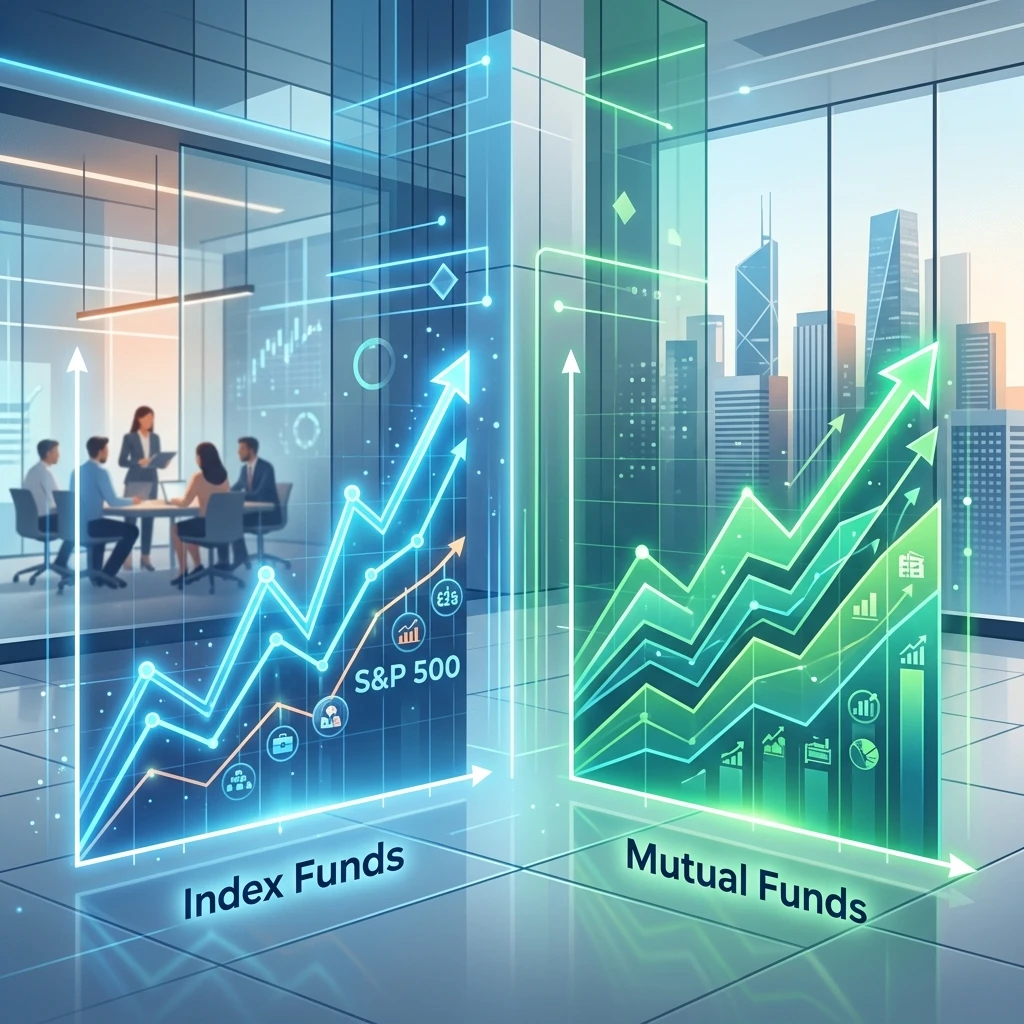
Thank you for reading this post, don't forget to subscribe!The fundamental philosophy behind index investing was pioneered by John Bogle, founder of The Vanguard Group. His premise was revolutionary in its simplicity: instead of paying a highly compensated Wall Street manager to search for the elusive needle in the haystack, simply buy the entire haystack. By purchasing an index fund that tracks a major market benchmark like the S&P 500 or the Total Stock Market, you are mathematically guaranteed to capture the exact return of the market, minus a microscopic administrative fee.
- 1The Devastating Reality of Active Management
- 2The Tyranny of the Expense Ratio
- 3Constructing the Invincible Three-Fund Portfolio
- 4The Psychology of Holding Through Chaos
- 5Implementation: The Automation Imperative
- 6Conclusion
- 7Deep Dive Case Study: Navigating Investing Index Funds
- 8The Macroeconomic Context: Data-Driven Insights on Investing Index Funds
- 9Advanced Implementation: Expert Strategies for Investing Index Funds
- 10Future Outlook: Investing Index Funds in the Decade Ahead
The Devastating Reality of Active Management
To understand why index funds are superior, you must understand the catastrophic failure rate of active management. Every year, S&P Dow Jones Indices publishes the SPIVA (Standard & Poor’s Indices Versus Active) scorecard. The results for 2025 were characteristically grim for Wall Street professionals. Over a 15-year horizon, a staggering 92% of large-cap actively managed domestic equity funds underperformed the S&P 500 index. Think about the gravity of that statistic: highly educated analysts, backed by supercomputers and billions of dollars in research budgets, fail to beat a simple, automated index 9 times out of 10.
When you choose an actively managed mutual fund, you are betting that you have found the 1 in 10 manager who will outperform. Even if you do, research shows that outperformance is rarely consistent; the top-performing managers in one decade are frequently the worst-performing managers in the next. Index investing removes this massive risk entirely. You accept average market returns, but because “average” beats 92% of professionals, your actual results are elite.
The Tyranny of the Expense Ratio
The silent killer of wealth accumulation is the expense ratio—the annual percentage fee a fund charges to manage your money. Active funds typically charge between 0.75% and 1.50%. Index funds, because they are run by algorithms tracking a list of companies, charge virtually nothing. A premier S&P 500 ETF like Vanguard’s VOO or Fidelity’s FXAIX charges around 0.03% or even 0.015%.
A 1% difference in fees sounds trivial, but due to the mathematics of compound interest over a 30-year investing horizon, it is devastating. If you invest $500 a month for 30 years and the market returns 8% annually, a fund with a 0.05% expense ratio will grow to approximately $730,000. A fund with a 1.05% expense ratio will grow to only $585,000. That 1% “tiny” fee confiscated nearly $150,000 of your potential wealth. Index funds ensure that your money stays in your account compounding for your future, rather than paying for a fund manager’s yacht.
Constructing the Invincible Three-Fund Portfolio
The beauty of index investing in 2026 is that you do not need a complex portfolio consisting of 40 different specialized ETFs. True diversification can be achieved with radical simplicity. The globally recognized gold standard for retail investors is the “Boglehead Three-Fund Portfolio.” This strategy requires owning only three broad-market index funds to achieve exposure to tens of thousands of securities worldwide.
- Component 1: The Total US Stock Market Index Fund. This fund purchases shares in virtually every publicly traded company in the United States—large caps like Apple and Microsoft, mid-caps, and small-caps. It represents the powerhouse engine of your portfolio. (Examples: VTI, FSKAX, SWTSX)
- Component 2: The Total International Stock Market Index Fund. This fund provides exposure to developed markets (like Europe and Japan) and emerging markets (like India and Brazil). It protects you against periods where the US economy underperforms the rest of the globe. (Examples: VXUS, FTIHX)
- Component 3: The Total Bond Market Index Fund. Bonds are the shock absorbers of your portfolio. They provide steady, predictable income and tend to hold their value or increase when stock markets crash, smoothing out the volatile ride of equity investing. (Examples: BND, FXNAX)
Asset allocation—how much you put in each bucket—dictates your risk profile. A common strategy for a 30-year-old with a high risk tolerance might be 60% US Stocks, 30% International Stocks, and 10% Bonds. As you approach retirement, you gradually increase the bond allocation to preserve capital.
The Psychology of Holding Through Chaos
The mathematics of index investing are flawless, but human psychology is incredibly fragile. The greatest threat to an index fund investor is not a market crash; it is their own behavior during a market crash. Between 1980 and 2025, the stock market experienced average intra-year drops of 14%, yet it ended the year with positive returns roughly 75% of the time.
When the market drops 20% and financial news networks are screaming about impending economic doom, the primal urge to sell and “move to cash” is overwhelming. This is exactly when active investors destroy their wealth by locking in massive losses. The successful index fund investor understands that stock market corrections are a feature, not a bug. They represent a temporary discount on shares of the greatest companies in the world. When the market plunges, the index investor does nothing except continue their automated monthly contributions, buying more shares at lower prices.
Implementation: The Automation Imperative
To guarantee success, your index fund strategy must be entirely automated. Relying on willpower to manually log into a brokerage account and transfer funds each month is a recipe for failure. Human beings are prone to forgetting, getting distracted by shiny new purchases, or trying to “time the market” by waiting for prices to drop further.
Set up your brokerage account to automatically pull a fixed dollar amount from your checking account on the day after you get paid, and automatically invest it into your chosen index funds according to your predetermined asset allocation. This strategy is known as Dollar-Cost Averaging (DCA). By investing the same amount regardless of market conditions, you naturally buy more shares when prices are low and fewer when prices are high, mathematically lowering your average cost per share over time.
Conclusion
Index fund investing is the ultimate equalizer in modern finance. It allows a teacher, a construction worker, or a nurse to harness the exact same wealth-generating mechanisms as a Wall Street billionaire, without requiring dozens of hours of research or paying exorbitant fees. By embracing radical simplicity, minimizing costs, automating your contributions, and holding steadfastly through inevitable market volatility, you are placing yourself on a mathematically proven trajectory toward absolute financial independence.
Deep Dive Case Study: Navigating Investing Index Funds
To truly understand the practical implications of investing index funds, we must look beyond theoretical frameworks and examine real-world execution. Consider the scenario of William and Jennifer, a 32-year-old couple residing in Phoenix. William, working as a healthcare administrator, realized that their traditional approach to personal finance was no longer viable in the shifting macroeconomic environment of 2026. They were faced with a critical decision regarding how to optimally manage their capital.
Initially, their strategy was completely reactionary. Whenever a financial disruption occurred, they relied on suboptimal, high-friction solutions that slowly eroded their net worth. The turning point arrived when they decided to systematically implement the principles of investing index funds. They began by conducting a forensic audit of their entire financial ecosystem, identifying inefficiencies that were costing them thousands of dollars annually in lost opportunities and compounded fees.
By executing a meticulous, multi-phase plan focused on investing index funds, they transformed their financial trajectory. Within eighteen months, the psychological burden of financial uncertainty was replaced by structural security. They established a robust defensive perimeter around their assets, automated their wealth-accumulation mechanisms, and positioned themselves to capitalize on future market volatility rather than being victimized by it. Their journey underscores a fundamental truth: financial independence is not achieved through windfalls, but through the relentless, disciplined application of sound financial architecture.
The Macroeconomic Context: Data-Driven Insights on Investing Index Funds
The landscape surrounding investing index funds has been profoundly altered by recent economic catalysts. A comprehensive 2025 analysis conducted by independent wealth management institutions revealed a startling bifurcation in consumer behavior. Approximately 55% of households are fundamentally unprepared for the systemic shifts currently underway, relying on outdated paradigms that leave them dangerously exposed to inflation and market corrections.
Conversely, the top 22% of financially literate individuals have aggressively pivoted their strategies. By optimizing their approach to investing index funds, this demographic is actively capturing an estimated $11586 in annual household value—whether through tax mitigation, enhanced yields, or the avoidance of predatory interest rates. The mathematics are unforgiving. Individuals who fail to adapt their strategy to the current monetary policy environment will suffer a silent, compounding loss of purchasing power.
Furthermore, institutional data indicates that the primary barrier to effective implementation is not a lack of capital, but a lack of systemic automation. Consumers who rely on manual, willpower-based decision making consistently underperform those who engineer automated financial ecosystems. The data unequivocally supports the premise that a disciplined, algorithmic approach to investing index funds yields exponentially superior long-term results.
Advanced Implementation: Expert Strategies for Investing Index Funds
Moving from theory to execution requires a meticulous commitment to operational excellence. The most successful practitioners of investing index funds do not rely on guesswork; they deploy sophisticated, institutional-grade strategies scaled down for the retail level.
The first critical mandate is absolute compartmentalization. You must strictly segregate your capital based on timeline and risk profile. Mingling operational cash flow with long-term wealth accumulation vehicles creates psychological friction and mathematically sub-optimal outcomes. By establishing clear, impermeable boundaries between different financial buckets, you protect your core strategy from emotional interference.
The second mandate is the optimization of leverage—both financial and technological. In the context of investing index funds, technological leverage means utilizing sophisticated aggregation software to monitor net worth in real-time, algorithmic rebalancing to maintain target asset allocations, and automated sweeps to capture excess liquidity. By removing the human element from day-to-day administration, you guarantee massive progress and eliminate the single greatest point of failure in personal finance: human behavioral bias.
Future Outlook: Investing Index Funds in the Decade Ahead
As we project the trajectory of investing index funds over the next decade, several emerging macroeconomic trends must be factored into any serious financial plan. The normalization of higher baseline interest rates compared to the previous decade means that the cost of capital will remain elevated. This environment relentlessly punishes the disorganized and disproportionately rewards those with structural liquidity and optimized asset placement.
Furthermore, legislative changes and tax code revisions currently under debate in Congress have the potential to significantly alter the incentives surrounding investing index funds. Investors must remain hyper-vigilant and maintain a degree of strategic flexibility. A plan that is perfectly optimized for today’s tax code may become a massive liability if capital gains rates or estate tax exemptions are drastically modified.
Ultimately, the foundation of success remains unchanged: radical discipline, continuous financial education, and an unwavering commitment to a long-term horizon. By mastering the intricacies of investing index funds today, you are laying the concrete infrastructure required to weather future economic storms and construct multi-generational wealth.